


Medically reviewed by Ryan Neeley, DO | Reviewed August 2026
“Nothing happened.” That is the sentence I hear more than any other when someone with a frozen shoulder sits down across from me. There was no fall, no lifting injury, and no single moment they can point to. The shoulder started aching one day, and four months later they cannot reach into the back seat of the car or fasten a seatbelt without wincing. Frozen shoulder treatment can be frustrating because the timeline runs in months rather than weeks. In this post, I’ll explain what is happening inside the joint, what I have found helps, and where I think people lose time.
Key Takeaways
- Frozen shoulder, also called adhesive capsulitis, develops when the joint capsule becomes inflamed, thickens, and contracts. It is not primarily a muscle or tendon problem, although other shoulder conditions can coexist.
- The condition is traditionally described in three overlapping phases and often takes one to three years to improve. Some patients retain a mild loss of motion even after the pain resolves.
- A well-timed corticosteroid injection during the painful phase can reduce pain and improve function in the short term, making gentle motion and therapy easier.
Understanding Frozen Shoulder
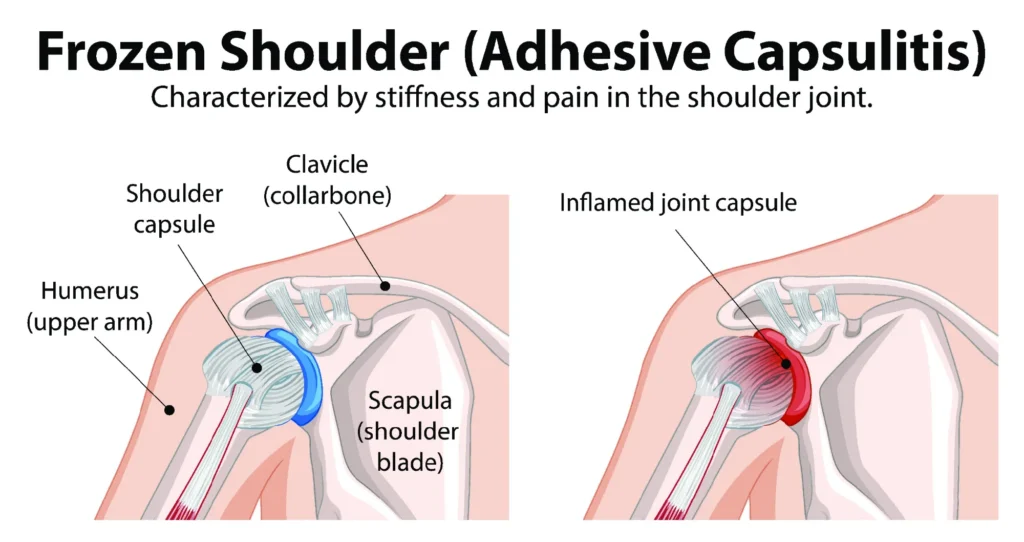
Your shoulder joint sits inside a sleeve of connective tissue called the capsule. In a healthy shoulder, that sleeve is loose and generous, which is part of why the shoulder moves through a greater range than any other joint in the body.
In frozen shoulder, the capsule becomes inflamed and then fibrotic. It thickens, loses elasticity, and contracts around the joint like shrink-wrap. The rotator interval and coracohumeral ligament at the front of the joint are commonly involved. That is why turning the arm outward often becomes difficult early.
The loss of motion is not simply a response to pain. Pain-related guarding can contribute, especially early, but the capsule also becomes physically restricted. That is why controlling pain may make movement easier without immediately restoring normal motion.
What Causes Frozen Shoulder, and Who Gets It?
Primary frozen shoulder develops without a clear trigger. Secondary frozen shoulder follows another problem, such as a fracture, surgery, or a period of immobilization. In other cases, an underlying shoulder disorder may contribute to the stiffness.
The condition most often appears between ages 40 and 60 and is more common in women. Diabetes and thyroid disease are among the strongest associated medical conditions.
What Are the Three Phases of Frozen Shoulder?
Frozen shoulder is traditionally described in three overlapping stages. The boundaries are not exact, and not every patient follows the same timetable:
The freezing phase: Pain is usually the dominant complaint, and motion progressively decreases. This phase commonly lasts about six weeks to nine months.
The frozen phase: Pain often begins to settle, but stiffness becomes the main limitation. This phase may last four months to a year.
The thawing phase: Motion gradually returns. This final phase can take another four months to two years.
I bring up the phases at the first visit for a reason. If patients do not understand which phase they are in, they cannot understand why the treatment plan changes over time. During the highly painful phase, forcing end-range motion can aggravate symptoms, so stretching should be gentle and matched to the shoulder’s irritability. As pain settles, progressively stronger capsular stretching may become appropriate.
What I See in My Patients
A common story I hear in my Chandler office is a patient who has already spent several months in therapy, worked hard, and made little progress. When I review the program, it often includes heavy strengthening and painful end-range stretching that began during the most irritable phase. The shoulder hurt more, the patient pushed harder, and the cycle escalated.
The second pattern I see is a patient who thought they had a rotator cuff tear, and in some cases a tear is even confirmed on MRI. But the tear on the scan may not explain why they cannot reach behind their back. The restricted capsule may be the primary problem.
I have also noticed that patients who are evaluated early tend to do meaningfully better. If they still have most of their motion during that first painful stretch, we have an opportunity to control inflammation and preserve motion.
How Do I Tell Frozen Shoulder From a Rotator Cuff Tear?
This part of the exam takes about 30 seconds. I have the patient relax completely, and I move the arm for them. This is passive range of motion. With an isolated rotator cuff tear, the patient may be unable to lift the arm on their own, but I can often move it for them because the joint itself remains mobile.
With frozen shoulder, I cannot move it normally either. External rotation is usually the first and most dramatic loss. When someone’s arm is at their side and the forearm stops well short of normal as I rotate it outward, capsular restriction moves high on the list of possible causes.
X-rays are still worth obtaining, primarily to rule out shoulder arthritis or a missed fracture because those problems can also cause stiffness. An MRI is not required to diagnose frozen shoulder, although I order one when the diagnosis is unclear or I suspect a significant rotator cuff problem beneath the stiffness.
My Approach to Treatment: Matching the Plan to the Phase
I treat this as a staged problem and match the intervention to the shoulder’s current level of pain and irritability.
During the painful phase, my priority is calming the joint down, not stretching it out. I often use an intra-articular corticosteroid injection early in this phase. The strongest evidence is for faster improvement in pain and function over the first six to 12 weeks. An injection does not guarantee a shorter overall course, but it can make gentle movement and therapy much more tolerable.
Alongside the injection, I want gentle motion rather than aggressive motion: pendulums, supported range of motion, and short, frequent sessions instead of one punishing hour. Anti-inflammatory medication may also help when it is medically safe. A sleep position that keeps the arm supported can improve quality of life during this stage.
Once the shoulder settles into the stiffer, less painful phase, the plan changes. Now I want a therapist working on progressive capsular stretching, and I want the patient repeating those exercises several times a day at home. The stretching should be challenging without repeatedly provoking severe pain. This is often when measurable gains become more consistent.
For patients with diabetes, I have a specific conversation before any injection about blood sugar. Corticosteroid can raise glucose noticeably for several days, so patients should know that ahead of time and have a plan for monitoring it.
I am patient with this condition, and I am open about why. Most frozen shoulders improve to a functional level without an operation. Surgery is generally reserved for persistent pain and stiffness after an appropriate course of nonsurgical treatment.
When Does Surgery Enter the Conversation?
Some patients eventually plateau. They have tried an injection and a structured therapy program for months, yet pain, stiffness, or both continue to limit daily life. For those patients, surgery can be reasonable.
Arthroscopic capsular release is the procedure I favor. Through small incisions, I release the thickened capsule and rotator interval under direct vision, which lets me control exactly what is released. Manipulation under anesthesia, in which the shoulder is moved while the patient is asleep, can also disrupt the contracture. I sometimes combine the two procedures.
The part people often underestimate is what comes afterward. A capsular release restores motion in the operating room; therapy helps preserve it. I begin range-of-motion work within a day and tell my patients that surgery is only one part of the recovery.
The Advice That Surprises People
The most common misconception I correct is that pushing through severe pain will loosen the shoulder. Patients tell me they have been forcing the arm overhead every morning because they think the capsule needs to be broken through. During the inflamed phase, repeatedly provoking severe pain usually makes the shoulder harder to manage. The goal is consistent, tolerable motion, not a daily battle with the joint.
When Should You See Dr. Neeley?
Consider an evaluation if you notice any of the following:
- Shoulder stiffness that has been building for weeks without a clear injury
- Loss of the ability to reach behind your back or across your body
- Night pain that regularly wakes you
- Diabetes accompanied by a shoulder that has started getting tight
I would also encourage an evaluation if you have been in therapy for a couple of months and your motion measurements have not improved. That often means the diagnosis or treatment plan needs to be reassessed. My shoulder practice serves Chandler and the surrounding East Valley.
Summary
Frozen shoulder is a capsular contracture that commonly progresses through a painful phase, a stiff phase, and a recovery phase. Treatment should match the shoulder’s irritability: calm pain and inflammation early with a well-placed injection when appropriate and gentle motion, then progress capsular stretching as the pain settles. Surgery is a reasonable option for the minority of patients who remain significantly limited after nonsurgical care, but it is not the starting point.
If your shoulder has been getting stiffer and you cannot turn your arm outward the way you used to, an in-office examination is the most useful next step. You can request an appointment here.
Frequently Asked Questions
How long does frozen shoulder last without treatment?
Frozen shoulder often improves over one to three years, although the timeline varies and some patients retain a mild loss of motion. Treatment may not eliminate every stage, but it can reduce pain, improve function, and help patients regain motion more comfortably. Evidence is strongest for short-term improvement rather than proof that every treatment shortens the condition’s total duration.
Can frozen shoulder come back in the same shoulder?
Recurrence in the same shoulder is uncommon. The opposite shoulder can develop frozen shoulder later; published series report this in a meaningful minority of patients, with higher risk among people with diabetes. If the other shoulder starts getting tight, do not assume it is a coincidence.
Will a cortisone shot fix my frozen shoulder?
A corticosteroid injection usually will not restore full motion by itself. Its main role is to reduce pain and inflammation, particularly early in the condition, so gentle motion and therapy are easier. The best-supported benefits occur over the first several weeks to a few months; long-term outcomes are often similar to those of other treatments.