

Medically reviewed by Ryan Neeley, DO | Reviewed May 2026
One of the most common questions I hear from patients considering rotator cuff repair is, “What is recovery like?” Before every procedure, I want my patients to understand not only what happens in the operating room, but also what recovery will look like over the months that follow. Surgery restores the tendon back to the bone. Rehabilitation restores strength, motion, and function. Both are essential to achieving the best possible outcome.
Key Takeaways
- Rotator cuff repair attaches a torn tendon back to the bone. Most repairs are performed arthroscopically using small incisions, resulting in less disruption to the surrounding tissues than traditional open surgery.
- Recovery moves through three phases: protection, active motion, and strengthening. Trying to rush between them is one of the more common ways patients set back their own recovery.
- Most patients make substantial progress during the first six months, but continued improvements in strength, endurance, and function commonly occur for up to a year after surgery.
What I See in My Practice
Most of my rotator cuff repair patients fall into two categories. The first is the active patient, often in their 50s to 70s, who has had shoulder pain for months, tried physical therapy, maybe had an injection, and is still limited. Their MRI shows a full-thickness tear that is unlikely to heal on its own. For many of these patients, surgery offers the best opportunity to restore strength and function. Their biggest concern usually isn’t the operation itself. It’s getting back to golf, swimming, pickleball, the gym, or simply being able to lift a grandchild without pain.
The second group is patients with an acute injury—a fall, a sudden pull, or a traumatic event where they immediately notice pain and weakness. In these cases, the decision to repair the tendon is often more straightforward, particularly in active individuals, although the recovery process is very similar.
What both groups have in common is that the patients who do best are the ones who go into surgery understanding what they’re committing to on the other side. The repair is just one day. The rehabilitation is months. Setting those expectations ahead of time helps patients stay engaged in the recovery process, and in my experience, that leads to better outcomes.
What Is the Rotator Cuff?
The rotator cuff is a group of four muscles and their tendons that wrap around the humeral head, the ball of the shoulder joint. Together, they stabilize the joint and power the arm through elevation, rotation, and overhead movement. The four muscles are called the supraspinatus, infraspinatus, teres minor, and subscapularis.
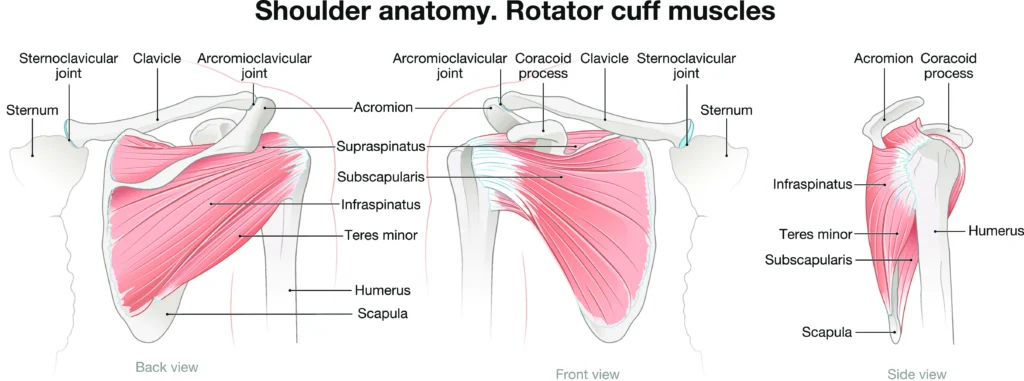
The supraspinatus is the most commonly torn tendon. It runs along the top of the shoulder and is vulnerable to both gradual degeneration and acute injury. The infraspinatus and subscapularis are less frequently involved but become important in larger, more complex tears.
A rotator cuff tear may involve only part of the tendon (partial-thickness tear) or the entire thickness of the tendon (full-thickness tear). Full-thickness tears do not heal on their own because the tendon has pulled away from the bone. Whether surgery is recommended depends on several factors, including the size of the tear, your symptoms, your functional limitations, and your activity goals.
When Is Rotator Cuff Repair Recommended?
Not every rotator cuff tear requires surgery. Many partial-thickness tears, and even some small full-thickness tears, can be managed successfully with physical therapy, activity modification, anti-inflammatory medications, or occasional injections. Patients who do well without surgery typically have smaller tears, manageable pain, preserved strength, and symptoms that don’t significantly interfere with their daily activities or goals.
Surgery becomes the more appropriate conversation when:
- A full-thickness tear is causing persistent pain or weakness that hasn’t improved with conservative care
- The tear is large or involves multiple tendons
- An acute traumatic tear in an active patient
- Significant loss of strength or shoulder function that limits work, daily activities, or sports
- Progressive weakness or worsening function over time
One point I emphasize during these discussions is that timing matters, particularly for larger tears. When a tendon is completely detached, it can gradually retract away from the bone while the muscle undergoes fatty degeneration and atrophy. Over time, a tear that is repairable today may become much more difficult (or in some cases impossible) to repair successfully. If surgery is likely to be the eventual treatment, delaying it unnecessarily may reduce the chance of achieving the best possible result.
How the Surgery Works
Most rotator cuff repairs I perform are done arthroscopically. That means small incisions, a camera, and specialized instruments, rather than opening the shoulder with a larger incision. The goals are the same as open surgery: reattach the torn tendon securely back to the bone and restore the normal anatomy of the shoulder.
During the procedure, I place small anchors into the bone and use strong sutures to bring the torn tendon back to its original attachment site, known as its footprint. The repair is designed to hold the tendon securely while your body heals it back to the bone over the following several months. If I find inflamed tissue, a bone spur, biceps tendon pathology, or other conditions contributing to pain, those can often be addressed during the same operation.
Larger or more complex tears sometimes require additional techniques or a modified repair strategy. In situations where the tendon cannot be fully repaired, other treatment options—such as tendon transfers, superior capsule reconstruction, or reverse shoulder replacement in select patients—may be discussed depending on the patient’s age, activity level, and goals. Before surgery, I review each patient’s MRI and explain the anticipated plan so they understand what I’m expecting to find and the possible treatment options.
What to Expect: The Recovery Timeline
Recovery after rotator cuff repair follows a predictable progression, but it requires patience. Tendon healing takes time, regardless of how good you feel. One of the most common mistakes I see is patients trying to advance too quickly because their pain has improved before the tendon has fully healed. Following the rehabilitation plan, and resisting the urge to do too much too soon, is one of the most important factors in achieving a successful outcome.
Phase 1: Protection (weeks 0–6). The repaired tendon is at its most vulnerable during the first several weeks after surgery. Your arm remains in a sling while the tendon begins healing back to the bone. During this phase, any shoulder motion is passive, meaning your therapist (or your other arm) moves the shoulder without activating the repaired rotator cuff muscles. The goal is to protect the repair while preventing excessive stiffness. Depending on the size of the tear and the quality of the repair, the sling is typically worn for 4 to 6 weeks.
Phase 2: Active motion (weeks 6–12). Once there is sufficient early healing, you’ll begin actively using your own muscles to move the shoulder. Therapy focuses on restoring motion, improving flexibility, and gradually reintroducing shoulder function. This is often when patients start feeling significantly better, which can create the temptation to do more than the repair is ready for. Although pain is improving, the tendon continues to mature and remains vulnerable to excessive stress.
Phase 3: Strengthening (months 3–6+). As healing continues, therapy shifts toward rebuilding strength, endurance, shoulder mechanics, and functional movement. Rotator cuff strengthening, scapular stabilization, and sport- or work-specific exercises are gradually introduced. The pace of recovery depends on factors such as the size and chronicity of the tear, tissue quality, age, and your activity goals.
Recovery Milestones I Discuss With My Patients
Every patient’s recovery is different, but these are the milestones I typically discuss before surgery:
Around 3 months: My goal is for patients to have regained nearly full range of motion and feel approximately 50-60% recovered. Most are becoming more comfortable with everyday activities but still lack strength and endurance.
Around 4½ months: Most patients feel 70-80% recovered. At this point, I typically lift activity restrictions and allow patients to gradually return to unrestricted daily activities while continuing to build strength.
Around 6 months: Most patients feel close to 90% recovered and have returned to many of the activities they enjoy, including golf, swimming, recreational sports, and gym workouts. Patients performing heavy overhead labor or high-level athletics may require additional time before returning without restrictions.
Up to 1 year: Although most recovery occurs during the first six months, strength, endurance, and overall shoulder function often continue improving for a full year after surgery.
Sleep Recovery After Rotator Cuff Repair
What About Sleeping?
One of the biggest surprises after rotator cuff repair isn’t shoulder motion—it’s sleep. Many patients tell me that sleeping comfortably is actually the hardest part of the early recovery process. Pain, inflammation, wearing a sling, and being unable to sleep on the operative side can all make it difficult to get a good night’s rest during the first several weeks.
Fortunately, this almost always improves with time. A 2022 study published in the Journal of Shoulder and Elbow Surgery found that among patients whose sleep eventually returned to normal, nearly half recovered by three months, about three-quarters by six months, and many of the remaining patients continued improving over the following year.
I discuss this before surgery because I don’t want patients to think something is wrong if they’re still struggling to sleep during the first couple of months. It’s frustrating, but it’s also a very normal part of recovery for many people.
My Approach to Rotator Cuff Repair
The technical side of a rotator cuff repair is only part of what I’m thinking about when I’m planning a case. The other part is what recovery is going to look like for this specific patient, such as their work, their home situation, who’s helping them while they’re in a sling, what they’re trying to get back to.
I perform nearly all rotator cuff repairs arthroscopically because it allows me to fully evaluate the shoulder while minimizing disruption to the surrounding tissues. The repair technique, anchor configuration, and fixation strategy are tailored to the tear pattern, tendon quality, and bone quality. My goal is always to create a repair that is both strong and biologically favorable for healing.
The patients who have the best outcomes usually have two things in common: they commit to the rehabilitation process, and they protect the repair during the early healing phase, even when they’re feeling better. The sling isn’t the most enjoyable part of recovery, and it’s natural to want to start using the arm sooner than recommended. But the tendon heals on biology’s timeline, not ours. I’d much rather prepare patients for that before surgery than have to treat a preventable setback afterward.
Summary
Rotator cuff repair is typically an outpatient procedure that takes just about an hour, but the recovery is where the real commitment begins. For patients with the right indications, restoring shoulder strength and function can be life-changing, but success depends on both a well-performed repair and a committed rehabilitation process. If you’re in Chandler, Gilbert, Mesa, or the surrounding Phoenix area and have persistent shoulder pain, weakness, or a known rotator cuff tear that hasn’t improved with conservative treatment, I’d be happy to evaluate your shoulder and discuss whether surgery is appropriate for your situation. Together, we can review your imaging, treatment options, and what you can realistically expect during recovery.
You can request an appointment online or call the office at 480-543-6700.
Frequently Asked Questions
How long do I have to wear a sling after rotator cuff repair?
Sling use is typically four to six weeks after surgery, though the exact duration may vary depending on the size of the tear and what was repaired. The sling is worn when you are up and around, but is removed whenever sitting.
Will I need physical therapy?
Yes. Physical therapy is a central part of recovery after rotator cuff repair, not optional. The repair restores the structural attachment of the tendon to bone, but physical therapy is what rebuilds strength, motion, and function.
What happens if a rotator cuff tear isn’t repaired?
Not every tear requires repair, and some patients do well with conservative management for years. For larger tears, however, leaving them unaddressed may allow the tendon to retract further and the surrounding muscle to atrophy, which can make a future repair more complex or, in some cases, no longer possible. Early evaluation helps establish the right plan before that becomes a concern.
Why is it so hard to sleep after rotator cuff repair?
Difficulty sleeping is one of the most common concerns after rotator cuff repair. During the first several weeks, pain, inflammation, wearing a sling, and the inability to sleep on the operative side can all make it difficult to get comfortable at night.
Fortunately, sleep gradually improves as the shoulder heals. A 2022 study published in the Journal of Shoulder and Elbow Surgery found that among patients whose sleep eventually returned to normal, nearly half did so by three months after surgery, about three-quarters by six months, and many of the remaining patients continued improving over the following year.
I routinely discuss this before surgery because I don’t want patients to become discouraged if they’re still struggling to sleep during the first couple of months. While frustrating, it’s an expected part of recovery for many patients and almost always improves with time.