


A humerus fracture — a break in the upper arm bone between the shoulder and elbow — can significantly affect your ability to move and use your arm. While many humerus fractures heal successfully with non-surgical treatment, certain fractures require surgery to restore proper alignment, stability, and arm function.
Modern orthopedic techniques allow surgeons to repair complex humerus fractures with excellent outcomes. Understanding when surgery may be necessary and what recovery involves can help patients feel more prepared and confident about their treatment plan.
In this guide, we’ll review the different types of humerus fractures, when surgery is recommended, the surgical techniques used, and what to expect during recovery.
Key Takeaways
• Surgery for a humerus fracture depends on the location of the fracture (proximal, shaft, or distal), the degree of displacement, and the patient’s functional needs.
• The goal of surgery is to restore proper alignment and stabilize the bone so it can heal correctly.
• Surgical treatment options may include open reduction and internal fixation (ORIF), intramedullary nailing (IMN), or shoulder replacement (arthroplasty) for complex fractures.
Understanding the Anatomy of a Humerus Fracture
Orthopedic surgeons typically divide the humerus into three main regions, and fracture patterns vary depending on the location of the break.
Proximal Humerus Fractures (Near the Shoulder)
These fractures occur in the upper portion of the bone near the shoulder joint and are common in older adults, often occurring after a fall onto an outstretched arm.
These injuries are commonly described using the Neer classification system, which is based on the number of displaced bone fragments (or “parts”).
Examples include:
• Two-part fractures
• Three-part fractures
• Four-part fractures
More complex injuries may involve the greater and lesser tuberosities, which are the attachment sites for the rotator cuff tendons.
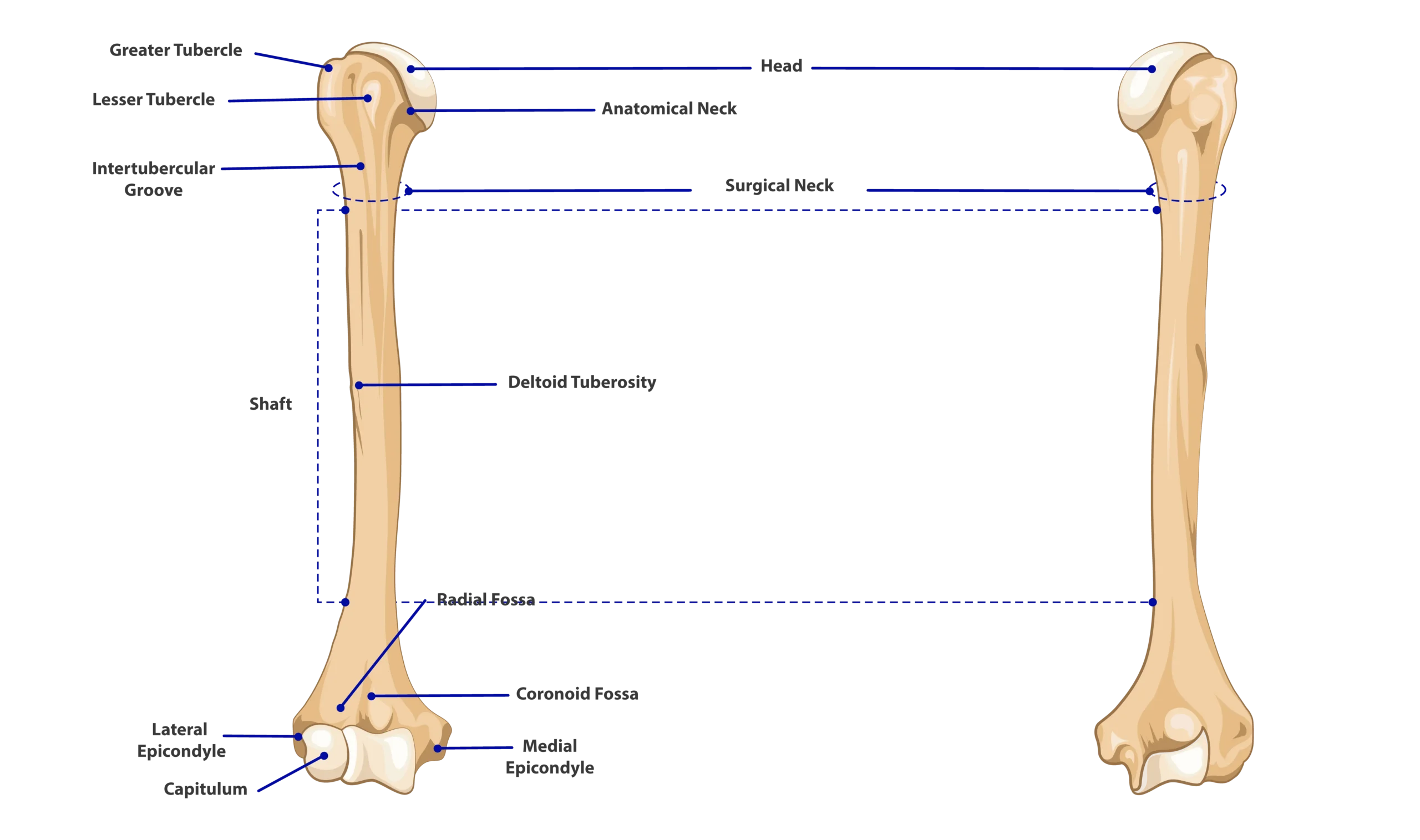
Humeral Shaft Fractures (Mid-Arm)
Humeral shaft fractures occur in the middle portion of the upper arm bone and are often caused by direct trauma, falls, or high-energy injuries such as motor vehicle accidents.
One important consideration with shaft fractures is the radial nerve, which runs along the humerus and controls the ability to extend the wrist and fingers. Injury to this nerve can sometimes occur at the time of fracture.
Distal Humerus Fractures (Near the Elbow)
Distal humerus fractures occur near the elbow joint. Although less common, these fractures often involve the joint surface itself, which requires precise repair to prevent long-term stiffness or arthritis.
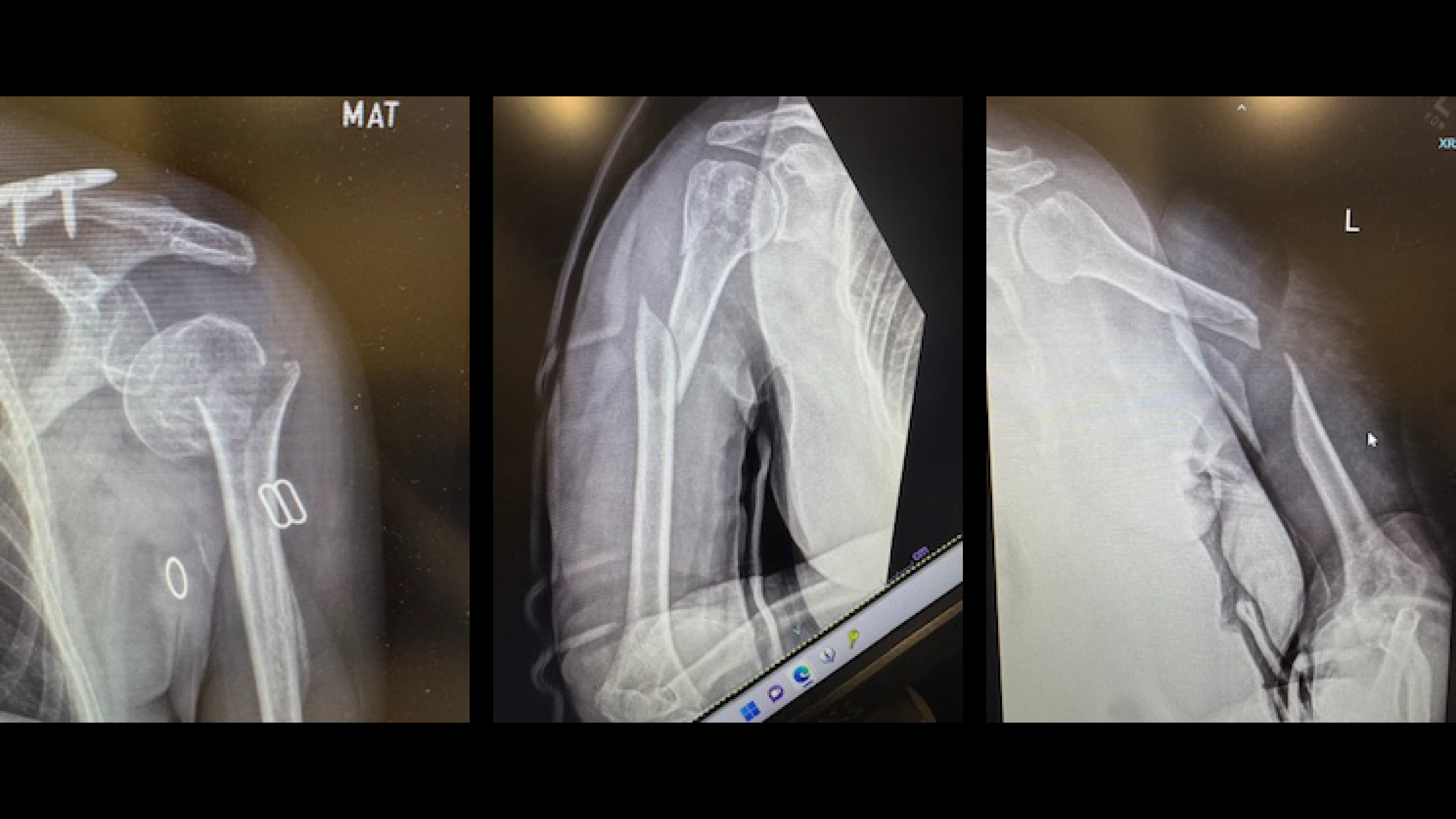
When Is Surgery for a Humerus Fracture Recommended?
Many humerus fractures can heal successfully with non-operative treatment, such as a sling or brace. However, surgery may be recommended when the fracture pattern makes proper healing unlikely without stabilization.
Common Reasons Surgery May Be Recommended
- Significant displacement – Bone fragments are far apart or poorly aligned.
- Instability – The fracture may shift during healing.
- Open fracture – The bone has broken through the skin, increasing infection risk.
- Nerve or vascular injury – Nearby nerves or blood vessels are affected.
- Intra-articular involvement – The fracture extends into the shoulder or elbow joint.
- Pathologic fracture – The bone is weakened by another condition such as a tumor or severe osteoporosis.
- Failure of non-operative treatment – The fracture does not heal properly (nonunion) or heals in poor alignment (malunion).
Common Surgical Techniques for Humerus Fractures
Open Reduction and Internal Fixation (ORIF)
ORIF is commonly used for proximal humerus fractures and humeral shaft fractures.
During this procedure:
• The surgeon makes an incision to directly visualize the fracture
• Bone fragments are realigned
• Plates and screws are used to hold the bone in position while it heals
Intramedullary Nailing (IMN)
Intramedullary nailing is frequently used for humeral shaft fractures.
A metal rod (nail) is inserted into the central canal of the humerus, spanning the fracture. Locking screws are placed at both ends of the rod to prevent rotation or shortening of the bone.
Arthroplasty (Shoulder Replacement)
For severe proximal humerus fractures, especially when the blood supply to the humeral head is compromised, shoulder replacement surgery may be recommended.
Types of Shoulder Replacement:
• Total Shoulder Arthroplasty – Both the humeral head and shoulder socket are replaced.
• Reverse Shoulder Arthroplasty – Often used for complex fractures when the rotator cuff is not functional, allowing the deltoid muscle to power the shoulder.
Recovery and Rehabilitation After Humerus Fracture Surgery
Recovery typically occurs in phases and is guided by your surgeon and physical therapist.
Phase 1: Protection and Early Motion
Passive range of motion exercises
Pendulum exercises
Gentle mobility exercises
Phase 2: Active Motion and Strengthening
Active range of motion
Isometric strengthening
Light resistance exercises
Phase 3: Advanced Strengthening and Return to Activity
Progressive resistance training
Functional exercises
Gradual return to full activity
Full recovery may take several months, with return to heavy lifting or contact sports often taking six months or longer.
When Should You See a Specialist for a Humerus Fracture?
You should consider seeing an experienced shoulder specialist if you observe:
• Severe shoulder or upper arm pain after a fall or injury
• Significant swelling or bruising
• Difficulty lifting or moving the arm
• Visible deformity of the arm
• Numbness, tingling, or weakness in the hand or wrist
• Persistent pain after a fracture that was initially treated without surgery
Early evaluation by a shoulder specialist can help ensure proper healing and restoration of function.

Frequently Asked Questions
When can I drive after humerus fracture surgery?
Patients should avoid driving while wearing a sling or while taking narcotic pain medication.
Many patients may be able to return to driving around two weeks after surgery, provided they are no longer taking narcotics and feel comfortable safely controlling the steering wheel. Recent studies suggest driving ability often returns to safe levels around this timeframe.
Patients should always follow the guidance of their surgeon before resuming driving.
Can a humerus fracture lead to arthritis?
Yes. If the fracture involves the joint surface, there is a risk of developing post-traumatic arthritis even after successful surgical repair. Proper alignment during surgery helps reduce this risk.
When does physical therapy start?
Physical therapy often begins within the first week after surgery, particularly for proximal humerus fractures, where early passive motion helps prevent shoulder stiffness.
Your surgeon will provide a customized rehabilitation protocol based on the stability of the fracture repair.