


Medically reviewed by Ryan Neeley, DO
Shoulder pain does not always follow a clear injury. No fall, no collision, no single moment you can point to, and yet your shoulder aches every morning, flares up when you reach overhead, or keeps you awake at night. If that sounds familiar, you are not alone.
When patients tell me, “I didn’t do anything to it,” that is actually a very common shoulder story. Pain does not require a fall, a pop, or a dramatic injury. Tendons can become irritated, arthritis can gradually become symptomatic, the shoulder capsule can tighten, and even the neck can create pain that feels as though it is coming from the shoulder. The pattern of pain, stiffness, weakness, and what movements reproduce the symptoms usually gives us important clues about the cause.
Key Takeaways
- Shoulder pain without a clear injury is very common and can come from the rotator cuff and bursa, frozen shoulder, arthritis, calcific tendinitis, the biceps tendon, or pain referred from the neck.
- The location of pain matters, but the combination of pain, stiffness, weakness, night symptoms, and the physical examination is usually more helpful than any one symptom by itself.
- Most atraumatic shoulder pain does not require surgery. Treatment should be matched to the diagnosis rather than using the same therapy, injection, or exercise program for every painful shoulder.
- X-rays are often the most useful first imaging study. An MRI can be helpful when a rotator cuff tear or other soft-tissue problem is suspected, but not every patient with shoulder pain needs an MRI.
Why the Shoulder Is Vulnerable to Pain Without Injury
The shoulder has more motion than almost any other joint in the body. That mobility is a strength, but it also means the joint depends heavily on the rotator cuff, deltoid, capsule, biceps tendon, and surrounding muscles to keep the ball centered and moving smoothly in the socket.
Those structures can become painful gradually. Sometimes the issue is inflammation or overload; sometimes it is stiffness, arthritis, tendon degeneration, or a change in the way the shoulder is moving. Importantly, age-related changes on an MRI do not automatically explain a patient’s pain. The imaging has to match the history and examination.
Common Causes of Shoulder Pain Without Injury
Rotator Cuff Tendinopathy, Bursitis, and Rotator Cuff Tears
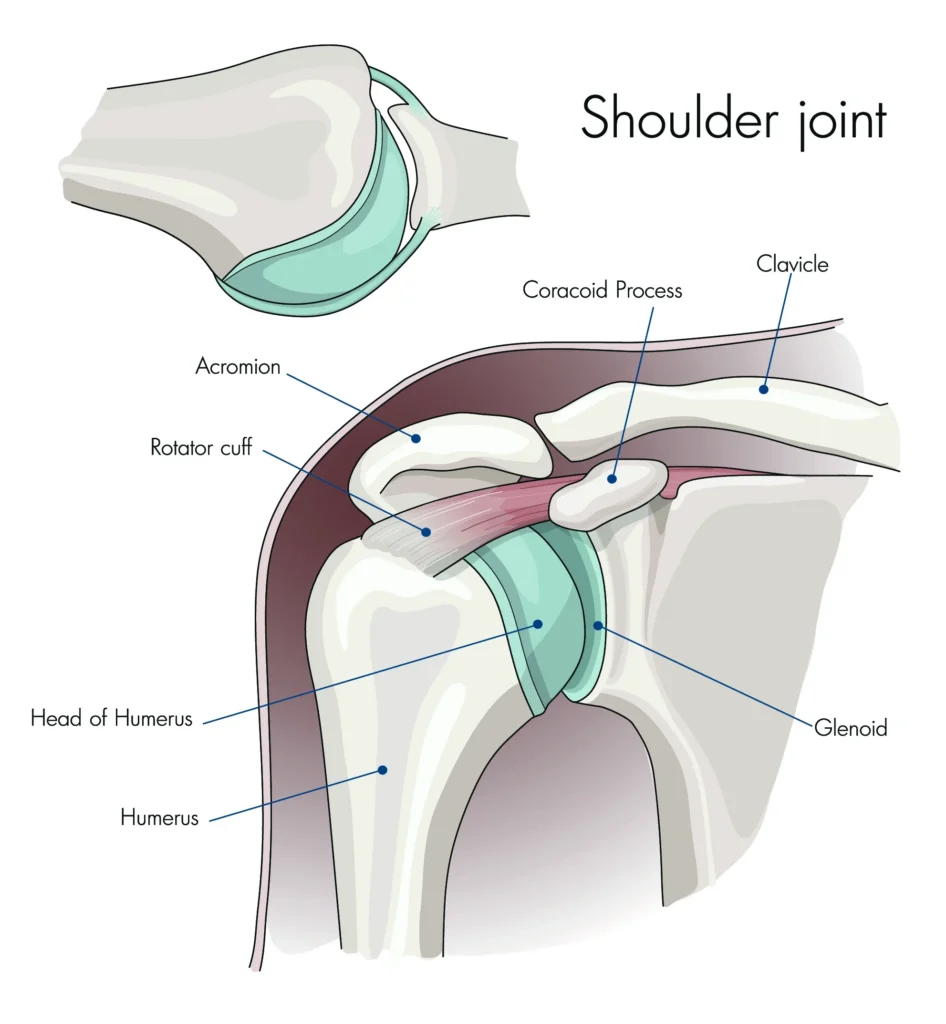
The rotator cuff is a group of four muscles and tendons that help lift and rotate the arm while keeping the humeral head centered in the socket. These tendons can become painful from repetitive use, age-related degeneration, or changes in shoulder mechanics. This is often described as rotator cuff tendinitis or, more accurately in many chronic cases, rotator cuff tendinopathy.
Typical rotator cuff pain is felt along the outer upper arm rather than directly on top of the shoulder. It often hurts with reaching overhead, lifting away from the body, or sleeping on that side. One point I emphasize to patients is that a rotator cuff tear can also develop gradually without a memorable injury. Some degenerative tears cause little or no pain, while others produce pain and weakness, so the MRI finding alone does not determine treatment.
Shoulder Bursitis
The subacromial bursa is a thin, fluid-filled sac that helps the rotator cuff glide beneath the acromion. It can become inflamed along with rotator cuff irritation and contribute to pain with elevation of the arm.
Bursitis and rotator cuff pain frequently overlap, which is why I do not think of them as completely separate diagnoses in many patients. The examination is often enough to identify this pain pattern; imaging is useful when the diagnosis is unclear, symptoms persist, or there is concern for a tear or another structural problem.
Biceps Tendon Pain
The long head of the biceps tendon can also cause pain in the front of the shoulder without a specific injury. Patients may notice pain with lifting, reaching, curls, or repetitive use. Biceps symptoms often overlap with rotator cuff or labral problems, so I use the location of tenderness, provocative testing, age, activity level, and imaging when needed to decide whether the biceps is actually the pain generator.
Frozen Shoulder (Adhesive Capsulitis)
Frozen shoulder is one of the classic causes of significant shoulder pain without an injury. The capsule surrounding the joint becomes inflamed, thickened, and contracted, leading to progressive pain and loss of motion. The key finding is not just that movement hurts – the shoulder actually becomes restricted when both the patient and the examiner try to move it.
Frozen shoulder usually evolves over months and can take a year or longer to fully resolve. Diabetes and thyroid disease are associated with a higher risk. In my practice, recognizing frozen shoulder early matters because the treatment strategy is different from the approach used for rotator cuff pain: restoring motion and controlling the painful inflammatory phase become the priorities.
Shoulder Osteoarthritis
Osteoarthritis occurs when the cartilage of the ball-and-socket joint gradually wears down. Patients commonly describe a deep ache, stiffness, loss of motion, and sometimes grinding or catching. Unlike rotator cuff pain, which may occur despite relatively preserved passive motion, arthritis often produces a more global loss of shoulder motion.
Shoulder arthritis can progress slowly over years and then reach a point where symptoms begin interfering with sleep, golf, exercise, work, or basic daily activities. A simple set of shoulder X-rays can usually show the diagnosis very clearly and is often more useful than an MRI for this problem.
Inflammatory Arthritis
Inflammatory conditions such as rheumatoid or psoriatic arthritis can involve the shoulder as part of a broader pattern of joint disease. Symptoms may include prolonged morning stiffness, swelling, warmth, and pain in multiple joints. When I suspect an inflammatory process, the shoulder evaluation is only one part of the picture, and coordination with the patient’s primary care physician or rheumatologist may be important.
Calcific Tendinitis
Calcific tendinitis occurs when calcium deposits form within a rotator cuff tendon, most commonly the supraspinatus. It can be present quietly for some time and then become extremely painful without any injury, particularly when the deposit enters a resorptive phase. X-rays often make the diagnosis immediately. Many cases improve without surgery, although injections, therapy, or ultrasound-guided procedures may be considered when symptoms are severe or persistent.
AC Joint Arthritis
The acromioclavicular (AC) joint, where the collarbone meets the acromion at the top of the shoulder, commonly develops arthritic changes over time. Heavy lifting and repetitive loading can make it symptomatic, but arthritis on an X-ray does not necessarily mean the AC joint is the source of pain.
When the AC joint is truly symptomatic, pain is usually localized to the top of the shoulder and is often reproduced by reaching across the chest, bench pressing, push-ups, or lying directly on that side. Tenderness directly over the joint is another useful clue.
Referred Pain From the Neck or Elsewhere
Not all pain felt around the shoulder actually starts in the shoulder. A pinched nerve or degenerative problem in the cervical spine can send pain into the shoulder blade, shoulder, or arm and can sometimes mimic rotator cuff symptoms.
Numbness or tingling, pain that travels below the elbow, symptoms that change substantially with neck position, or neurologic weakness make me more suspicious of a cervical source. Shoulder and neck problems can also coexist, so a careful examination of both areas is sometimes necessary.
How Is Non-Traumatic Shoulder Pain Diagnosed?
For atraumatic shoulder pain, the diagnosis starts with the story and the examination. I want to know where the pain is located, whether the shoulder is stiff or weak, what movements reproduce the pain, whether symptoms travel down the arm, and whether the pain is affecting sleep or function. I then compare active motion with passive motion and test the rotator cuff, biceps, AC joint, and, when appropriate, the neck.
I generally start with shoulder X-rays when symptoms are persistent enough to require an orthopedic evaluation. X-rays can identify arthritis, calcific tendinitis, changes in the AC joint, and other bony abnormalities. MRI is most useful when the history and examination raise concern for a rotator cuff tear or another soft-tissue problem, or when symptoms are not improving as expected. The goal is not simply to find an abnormality on a scan; it is to determine which finding actually explains the patient’s symptoms.
Treatment Options for Shoulder Pain Without Injury
The treatment for shoulder pain without an injury depends on the diagnosis. A stiff frozen shoulder, an arthritic shoulder, and a painful rotator cuff should not automatically receive the same treatment plan. In many patients, we can improve pain and function without surgery by matching treatment to the structure that is actually causing the problem.
Physical Therapy and Exercise
Physical therapy can be very effective, but it should be diagnosis-specific. Rotator cuff-related pain often benefits from progressive cuff and scapular strengthening. Frozen shoulder requires an emphasis on restoring motion without repeatedly aggravating the shoulder. Arthritis may benefit from maintaining motion and strength while avoiding exercises that consistently provoke joint pain.
Medications and Injections
Anti-inflammatory medications such as ibuprofen or naproxen may provide short-term relief when they are safe for the individual patient. Corticosteroid injections can also be useful, but the location and timing matter. A subacromial injection, an AC joint injection, and a glenohumeral joint injection are treating different potential pain generators. I use injections as a targeted treatment – and sometimes as a diagnostic tool – rather than as a generic answer for every painful shoulder.
Activity Modification and Rest
Temporarily reducing the specific activities that repeatedly flare the shoulder can help, but complete rest is rarely the long-term answer. I usually want patients to keep the shoulder moving within a tolerable range while we address the underlying problem and gradually rebuild strength or motion as appropriate.
Surgical Treatment
Surgery is not the usual starting point for atraumatic shoulder pain. It becomes appropriate when there is a structural diagnosis for which surgery is likely to improve pain or function and nonoperative treatment has not met the patient’s goals. Examples include symptomatic rotator cuff tears in selected patients or advanced glenohumeral arthritis that remains limiting despite nonsurgical care. Shoulder replacement may be an option for end-stage arthritis, with the specific implant – anatomic or reverse – determined by the patient’s anatomy, rotator cuff function, deformity, and other factors.
In my practice, I do not recommend surgery simply because an MRI or X-ray looks abnormal. The imaging, examination, symptoms, functional limitations, and patient’s goals all need to tell the same story. That is especially important in the shoulder, where imaging findings that come with aging are common even in people who feel perfectly well.
When Should You See Dr. Neeley for Shoulder Pain?
Not every shoulder ache requires an immediate specialist visit. But pain that persists, progresses, repeatedly interrupts sleep, or causes meaningful stiffness or weakness deserves an evaluation – especially when it is limiting the activities you want or need to do.
Consider scheduling an appointment if you are experiencing any of the following:
- Shoulder pain that has persisted without improvement
- Pain that wakes you from sleep or prevents you from sleeping on the affected side
- Significant stiffness or difficulty performing routine activities such as reaching overhead, getting dressed, or lifting light objects
- Numbness, tingling, or weakness in the arm or hand accompanying shoulder discomfort
- A sensation of grinding, clicking, or catching during shoulder movement
Seek more urgent medical evaluation for a hot, red, markedly swollen shoulder; fever or systemic illness with new shoulder pain; sudden unexplained inability to raise the arm; or shoulder discomfort accompanied by chest pain, shortness of breath, sweating, or other concerning symptoms.
Summary
Shoulder pain without an injury is common, and the absence of a traumatic event does not mean there is nothing structurally wrong. Rotator cuff tendinopathy or a degenerative tear, bursitis, frozen shoulder, arthritis, calcific tendinitis, biceps-related pain, and problems referred from the neck can all begin gradually.
The most important step is identifying the actual pain generator. In many cases, the history, physical examination, and a good set of X-rays provide most of the information we need. MRI is valuable when it answers a specific question, but it is not automatically the first or best test for every painful shoulder.
If shoulder pain is affecting your sleep, motion, strength, work, exercise, or daily activities, an evaluation with a shoulder specialist can help clarify the diagnosis and build a treatment plan around your goals.
Frequently Asked Questions
Can shoulder pain develop without any injury?
Yes. In fact, many of the shoulder problems I see develop without a specific injury. Rotator cuff tendinopathy and degenerative tears, bursitis, frozen shoulder, arthritis, calcific tendinitis, and biceps tendon problems can all become symptomatic gradually.
How do I know if my shoulder pain is serious?
Pain lasting more than a few weeks is worth evaluating when it is not improving, repeatedly disrupts sleep, causes progressive stiffness, or is associated with meaningful weakness, numbness, or tingling. A hot, red, swollen shoulder with fever or systemic illness warrants more urgent evaluation. Shoulder-area pain associated with chest pain, shortness of breath, or sweating should be treated as a medical emergency rather than assumed to be a shoulder problem.
Is surgery usually required for shoulder pain without injury?
No. Most atraumatic shoulder pain is treated without surgery. The key is getting the diagnosis right first. Physical therapy, activity modification, anti-inflammatory medication when appropriate, and targeted injections may all have a role. Surgery is reserved for specific structural problems when symptoms and functional limitations justify it and appropriate nonsurgical treatment has not been enough.
What can I do at home while waiting to be seen?
Keep the shoulder gently moving, but avoid repeatedly forcing the exact motion or activity that causes a major flare. Ice or heat can be used for comfort. Over-the-counter anti-inflammatory medication may help some patients if it is safe with their medical history and other medications. If you are developing progressive weakness, major stiffness, neurologic symptoms, or any of the urgent warning signs above, do not simply wait for a routine appointment.