


A shoulder subluxation typically feels like your shoulder slips out of place and then quickly slides back in. Most patients describe a sudden shifting, popping, or “out and back in” sensation, often followed by soreness or a lingering feeling of instability.
Many people ask, “What does a shoulder subluxation feel like?” The answer varies from person to person, but understanding the common sensations, symptoms, and warning signs can help you recognize this condition and seek appropriate care.
Key Takeaways
- A shoulder subluxation is a partial dislocation that resolves on its own, without manual reduction.
- Most patients feel a slip, shift, or pop, often described as the shoulder “going out and back in.”
- The shoulder often feels unstable afterward, even if pain improves quickly.
- Patients under 25 have around a 70–90%+ recurrence risk without treatment.
- Repeated instability events can lead to labral tears and progressive bone loss.
- The direction of instability (anterior, posterior, or multidirectional) affects both diagnosis and treatment strategy.
Understanding Shoulder Subluxation
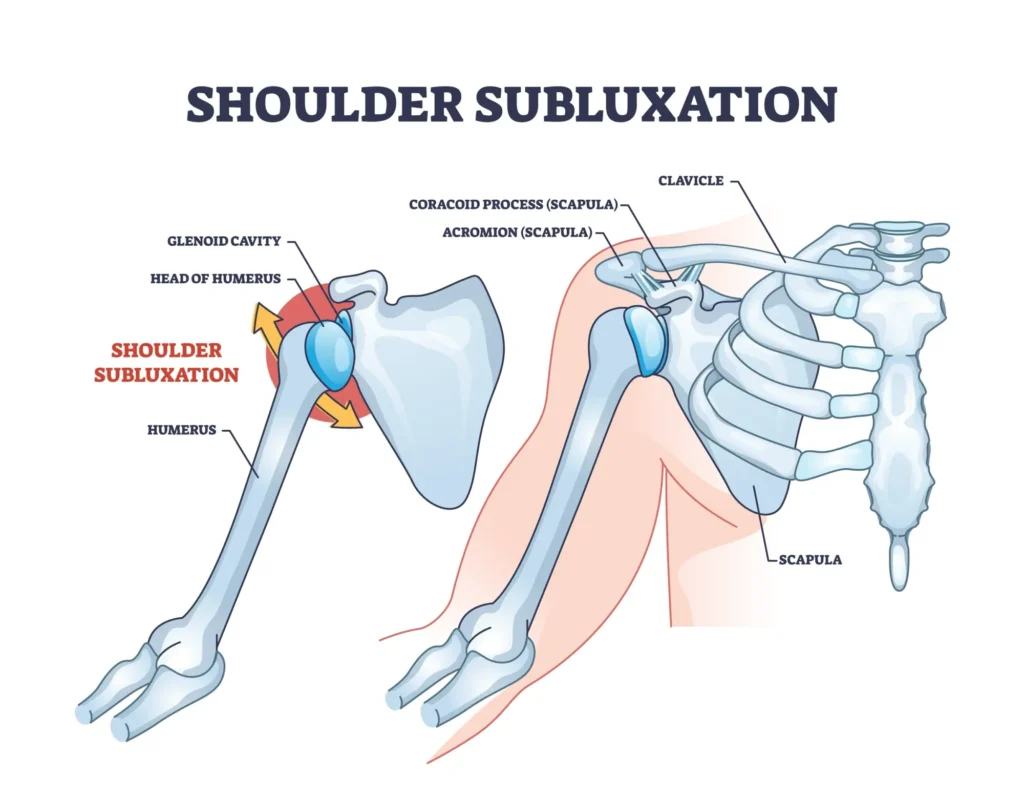
Your shoulder is a ball-and-socket joint where the humeral head (the ball) sits in the glenoid socket (part of your shoulder blade). This design allows a wide range of motion but comes with a tradeoff. The socket is relatively shallow, making the shoulder more prone to instability compared to other joints.
During a subluxation, the humeral head partially slides out of the glenoid socket but doesn’t fully dislocate. The joint then frequently relocates on its own. This differs from a complete dislocation, where the humeral head moves entirely out of position and usually requires medical intervention to put it back in place.
What Does a Shoulder Subluxation Feel Like in the Moment?
When a shoulder subluxation occurs, most people immediately recognize that something is wrong. Patients commonly describe a distinct feeling of something shifting or slipping within the shoulder, a sudden sense that the joint has “gone out” or moved in a way it shouldn’t. Athletes sometimes describe their arm going “dead” briefly during the episode.
Common descriptions I hear from my patients include:
- “It felt like my shoulder slipped out and back in”
- “I felt a pop or clunk”
- “My arm suddenly felt weak or unstable”
The intensity of pain varies widely. Some people experience sharp pain during the subluxation event, while others describe it more as an uncomfortable sensation of wrongness rather than severe pain. The sensation usually lasts seconds, but the instability can persist. When present, pain typically concentrates in the front, back, or top of the shoulder depending on which direction the humeral head shifted.
What Does It Feel Like Afterward?
After the shoulder slides back into place, patients often report soreness, a feeling that the shoulder might come out again, mild swelling, or hesitation with movement. Some patients describe a lingering sensation of instability, as though their shoulder might slip out again at any moment.
Even if pain improves quickly, the underlying instability often remains.
What Movements Can Cause Shoulder Subluxation?
Many people begin to recognize specific positions or movements that trigger their shoulder subluxations. Common triggers include:
- Overhead activities such as throwing or swimming
- Reaching behind or above the body
- Sleeping with the arm overhead
- The “throwing position,” where arm is elevated and externally rotated
These positions place stress on the front of the shoulder where instability most commonly occurs.
Athletes who participate in sports requiring repetitive overhead motion, such as baseball, volleyball, or tennis, may notice subluxations during particular phases of their sport-specific movements.
The Catch and Release Phenomenon
Some patients describe what might be called a “catch and release” sensation during shoulder movements. As you move your arm through certain ranges of motion, you might feel the shoulder catch or hang up momentarily before releasing and continuing the movement. This catching sensation may represent a partial subluxation that immediately reduces, though it can also indicate other shoulder pathology.
Can Shoulder Subluxation Happen in Different Directions?
Yes. Approximately 95% of subluxations occur in the anterior (front) direction. Anterior instability is most commonly associated with trauma, contact sports, and overhead activity. It frequently involves a Bankart lesion, a tear of the labrum at the front of the socket. The labrum is the most commonly damaged structure in these cases, and a key reason the shoulder becomes prone to repeat instability. Some patients also experience multidirectional instability, where the shoulder slips in more than one direction, which is more common in people with underlying ligamentous laxity.
Posterior instability, where the shoulder shifts backward, is less common and often harder to recognize. It tends to occur in weightlifters, football linemen, and athletes who perform repetitive pushing movements. Rather than a clear “out and back in” sensation, patients may describe pain with pushing activities like bench press, a sliding sensation in the back of the shoulder, or decreased performance rather than obvious instability.
One of the most common misconceptions I encounter is that all shoulder instability feels the same. In reality, anterior instability is often dramatic and obvious, while posterior instability can be much more subtle. Identifying the direction of instability is important, not just for diagnosis but because treatment differs depending on which way the shoulder shifts.
In my practice, recognizing these patterns early is key to avoiding prolonged symptoms and getting patients back to their desired level of activity.
Muscle Spasms and Guarding
Following a subluxation, the muscles surrounding your shoulder may respond by tightening or spasming. This protective response, while natural, can create additional discomfort. The muscles may feel tight, knotted, or fatigued.
Your body may unconsciously limit your shoulder motion to avoid positions that could trigger another subluxation. This pattern, while potentially preventing repeat episodes in the short term, may lead to progressive stiffness and weakness if it continues over time without proper treatment.
Why Does Shoulder Subluxation Keep Happening?
Once the shoulder becomes unstable, it often does not fully return to normal on its own. A subluxation is usually not just a one-time event; it is often a sign that the stabilizing structures of the shoulder have been stretched or injured.
As mentioned before, the most commonly affected structure is the labrum, which helps deepen the socket and keep the shoulder centered. When this is damaged, along with the capsule and ligaments, the shoulder becomes more prone to slipping out of position.
In many patients, especially younger and active individuals, this creates a cycle. The first episode may require a significant force or injury, but subsequent episodes often occur with less stress and during more routine movements. Each instability event can lead to:
- Further stretching of the capsule and ligaments
- Additional labral damage
- Progressive bone loss from the socket or humeral head
As this progresses, the shoulder becomes easier to subluxate and less stable overall. What starts as an occasional event can become more frequent and unpredictable.
In my practice, I often see patients whose symptoms begin with subtle instability or occasional subluxation, but over time progress to more frequent episodes or even full dislocations. This progression is one of the main reasons early evaluation is important, particularly in younger patients where recurrence rates are highest.
How Is Shoulder Subluxation Treated?
Treatment depends on age, activity level, recurrence risk, and direction of instability. Recurrence rates generally vary by age group:
- Under 20: up to 85–95% recurrence risk
- Ages 20–25: approximately 70–90%
- Ages 25–40: approximately 40–60%
- Over 40: lower recurrence risk, though with a higher risk of associated rotator cuff injury
These numbers matter, particularly for younger patients who may underestimate how likely another episode is.
For older or lower-demand patients, non-operative treatment is often appropriate. This typically includes a short period of immobilization with a sling, physical therapy to strengthen the surrounding muscles and compensate for stretched ligaments and capsular structures, and a gradual return to activity.
In younger, active patients, recurrence risk is very high, and repeated instability events can lead to progressive damage and more complex problems.
In my practice, I frequently recommend early surgical stabilization for:
- Patients under 25
- Athletes, especially those in contact or overhead sports
- Patients with recurrent instability
- Patients with structural damage visible on imaging
A common question is whether it makes sense to wait and see. The challenge is that each additional instability event increases the risk of bone loss, further damage to stabilizing structures, and complexity of any future surgery. What could have been a straightforward procedure early on can become a more involved operation later. Early evaluation and decision-making can make a meaningful difference in long-term outcomes.
When Should You See Dr. Neeley?
You should consider evaluation if you experience:
- A sensation of the shoulder slipping or shifting
- Recurrent subluxations or episodes where the shoulder “goes out and back in”
- Pain or apprehension with overhead or athletic movements
- A shoulder that doesn’t feel stable, even if pain is minimal
- A prior dislocation (especially if you are under 30 or active)
In younger and active patients, shoulder instability often does not resolve on its own and can worsen over time. Early evaluation allows for a more accurate diagnosis and helps prevent progressive damage that can make treatment more complex later. Consultation with an experienced orthopedic specialist can help determine the underlying cause and the right path forward.
If you are in the Phoenix or Chandler area and experiencing these symptoms, a consultation can help determine the best approach based on your age, activity level, and goals.
Summary
A shoulder subluxation feels like the shoulder briefly slips out and back into place. While it may resolve quickly, it is often a sign of underlying instability.
Each person’s experience may vary based on the direction of instability, the severity of structural damage, and individual factors, but the common thread is that sense of something moving incorrectly within the shoulder joint.
Early evaluation can help prevent recurrence and long-term damage.
Frequently Asked Questions
Can a shoulder subluxation happen without injury?
Yes, shoulder subluxations can occur without a specific traumatic injury, particularly in individuals with underlying shoulder laxity or previous damage to stabilizing structures. Some individuals experience subluxations during routine activities like reaching overhead or sleeping in certain positions.
How do I know if I had a subluxation versus a complete dislocation?
The primary difference is that a subluxation typically resolves on its own, with the joint sliding back into position spontaneously. A complete dislocation usually remains out of place and requires someone to manually reduce (relocate) it. Dislocations generally cause more severe pain and obvious deformity visible from the outside.
Will I need surgery after a shoulder subluxation?
Not always, but many patients, particularly younger and more active individuals, benefit from early surgical stabilization. The decision depends on age, activity level, direction of instability, and recurrence risk. Older or lower-demand patients often do well with physical therapy and a gradual return to activity. In younger patients, especially those under 25 or playing contact sports, the recurrence risk without surgery is high enough that early stabilization may be the more predictable path to long-term shoulder health.