


Medically reviewed by Ryan Neeley, DO | Reviewed August 2026
Two patients can sit down in my office describing the same thing. Pain on the outside of the shoulder. Can’t sleep on that side. Trouble reaching a shelf or getting a jacket on. Even though the symptoms are similar, one of them has a torn rotator cuff, and the other has an intact cuff and a pinched, inflamed space above it. Sorting out shoulder impingement vs rotator cuff tear from symptoms alone is challenging. In this post, I’ll detail how I separate them and why knowing the distinction is important.
Key Takeaways
- Impingement and a rotator cuff tear share almost all the same symptoms, including night pain and painful overhead reaching.
- True weakness, not pain, is the finding that most reliably points toward a tear.
- An MRI finding alone does not mean a rotator cuff tear is causing your pain; the physical exam and your symptoms need to match the imaging.
What Is Shoulder Impingement?
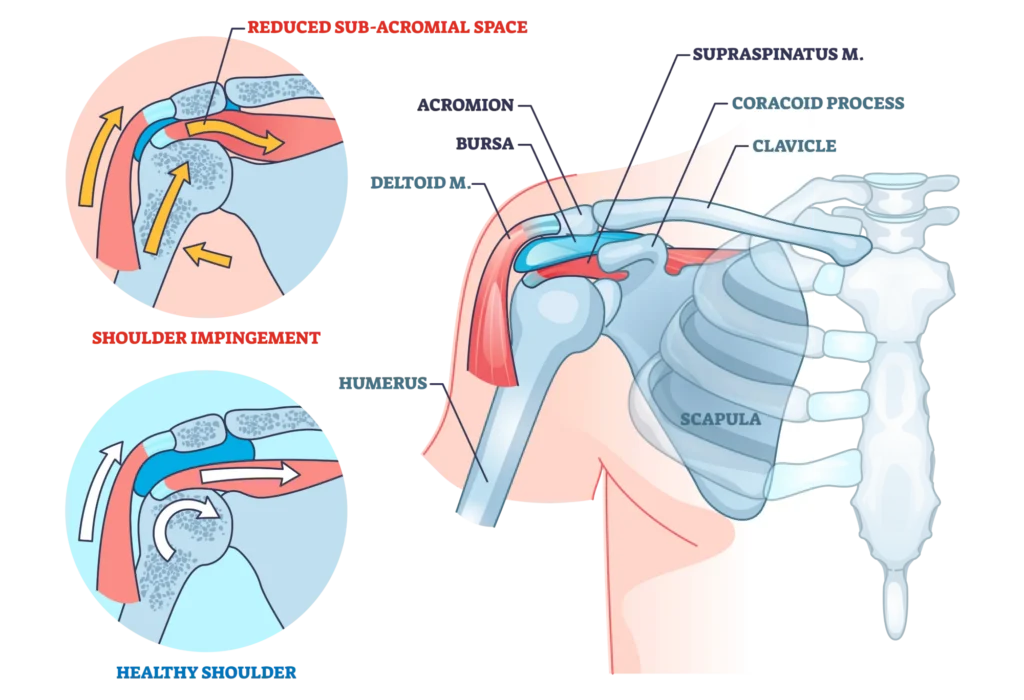
Impingement happens when the space beneath the acromion, the bony roof of the shoulder, gets functionally too narrow. The rotator cuff tendons and the bursa that cushions them get compressed and irritated as you lift your arm.
Sometimes the narrowing is anatomic, from a hooked or spurred acromion. More often what I see is a functional problem. The shoulder blade isn’t moving well, the cuff isn’t holding the ball centered in the socket, and the humeral head rides upward slightly with elevation. The space isn’t small at rest. It gets small when you move.
That distinction shapes treatment. You can’t stretch away a bone spur, but you can absolutely change how a shoulder blade moves.
What Is a Rotator Cuff Tear?
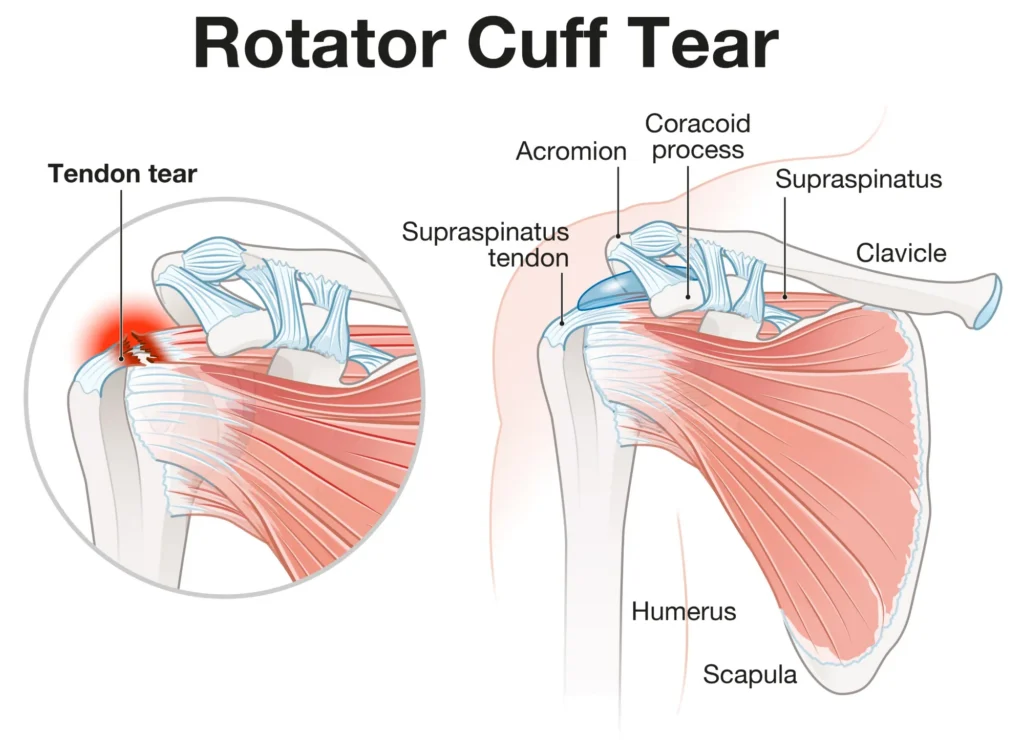
A tear is structural. The tendon itself has partially or completely separated from the bone.
The supraspinatus, which sits on top and initiates lifting the arm, is the most commonly involved. Tears fall into two broad groups, and they behave differently. Degenerative tears develop slowly over years from accumulated wear. Acute traumatic tears happen in a moment, usually a fall or a hard pull.
A small tear isn’t necessarily a mild problem and a large one isn’t automatically a surgical emergency. What I’m weighing is how much the tear affects strength, whether the tendon still has good quality tissue to repair, and what the person needs the shoulder to do.
How Do You Tell Them Apart?
I want to be honest that a few of the symptoms patients rely on most are useless for sorting this out.
Night pain doesn’t distinguish them. Both wake people up.
A painful arc between roughly 60 and 120 degrees of elevation shows up in both. It tells me the subacromial space is irritated, not what’s causing it.
Weakness is a finding that carries weight, but only if I can separate genuine weakness from pain inhibition. Someone with severe bursitis due to impingement will test weak simply because pushing hurts. To sort that out, I may use a subacromial injection of local anesthetic and then retest the strength a few minutes later. If the pain goes away and the strength comes back, I’m dealing with impingement. If the pain goes away and the arm is still weak, there’s a structural problem underneath.
A lag sign is another finding that can be helpful. If I position the arm in external rotation and let go, and it drifts back toward the body instead of holding, that tendon isn’t doing its job.
Age and mechanism shift the odds before I’ve touched the shoulder. A 35-year-old swimmer with gradually worsening pain is far more likely to have impingement. A 62-year-old who fell off a ladder and can’t lift the arm is a different conversation.
What About Imaging?
I get X-rays on essentially everyone, because they show acromial shape, arthritis, and whether the humeral head has migrated upward, which is a strong hint at a large chronic tear.
MRI is where patients get led astray. Studies of people with no shoulder pain whatsoever have found rotator cuff tears in a substantial share of those over 60, with the rate climbing further with age. Many of these tears will never cause a problem.
So, my rule is straightforward. Imaging confirms what the exam already suggested, or it makes me look harder at a mismatch. I don’t let a report drive a surgical decision when the physical findings don’t support it.
What I See in My Patients
A pattern I see often is a patient who arrives convinced they need surgery because their MRI report contains the word tear. When I examine them, their strength is intact, their pain pattern doesn’t match the tendon on the report, and the thing actually limiting them is an inflamed bursa and poor scapular mechanics. That MRI wasn’t wrong. It just wasn’t the whole story. Degenerative cuff changes are close to universal past a certain age, and finding one on a scan doesn’t establish that it’s the reason your shoulder hurts.
I also see a steady stream of pickleball players in the East Valley with classic impingement. Volume goes up fast in that sport, the serve and overhead put the shoulder in exactly the wrong position repeatedly, and people play four days a week here because the weather allows it.
My Approach to Treatment: Two Different Problems
For impingement, my plan is almost always nonoperative.
Physical therapy is the core of it, and the program has to target the right things: scapular control, posterior capsule mobility, and rotator cuff strength through a pain-free arc. Generic shoulder exercises tend not to work here. Activity modification means adjusting the volume and the positions that provoke it rather than shutting things down entirely. A subacromial injection can be useful, both to break a pain cycle that’s preventing progress in therapy and, as described above, as a diagnostic tool.
For a rotator cuff tear, the decision depends on the tear and the patient. An acute full-thickness tear in an active person with real weakness is something I want to address early, because tendons retract and muscle quality declines with time. A small degenerative partial tear in someone with good strength often does well with a non-surgical rehabilitation program.
When rotator cuff repair is the right call, the surgery and the recovery timeline are their own long conversation, and the commitment to rehabilitation afterward is the part patients underestimate most.
When Should You See Dr. Neeley?
Consider an evaluation at my Chandler office if you notice any of the following:
- Shoulder pain that hasn’t improved after several weeks of rest or home exercises
- Weakness lifting the arm, especially if it came on suddenly after a fall or a pull
- An inability to hold the arm up once someone else lifts it for you
- Night pain that’s disrupting sleep on a regular basis
I’d particularly encourage prompt evaluation if you felt a pop and had immediate weakness. That combination is the one where waiting can genuinely narrow your options.
Summary
Impingement and rotator cuff tears overlap so heavily in how they feel that symptoms alone rarely separate them. What separates them is true weakness on exam, lag signs, the response to a diagnostic injection, and the mechanism that started it. Imaging supports that picture rather than replacing it, since tears show up commonly on scans of shoulders that feel fine. Impingement usually improves with a well-targeted rehabilitation program, while an acute tear with weakness is worth addressing sooner rather than later.
If you’re experiencing persistent shoulder pain and aren’t sure what you’re dealing with, you can request an appointment here.
Frequently Asked Questions
Can shoulder impingement turn into a rotator cuff tear?
They’re related, and years of impingement and tendon irritation can contribute to a tendon eventually failing. That progression isn’t inevitable, though, and plenty of people have impingement for years without ever developing a tear. Keeping the cuff strong and the shoulder blade moving well is the most useful thing you can do to influence it.
Does a rotator cuff tear always need surgery?
No. Many degenerative tears do well with rehabilitation, particularly smaller ones in patients who still have good strength. The tears I push to repair are acute full-thickness tears in active patients, tears causing meaningful weakness, and tears that haven’t responded to a course of therapy.
Can you have a rotator cuff tear without knowing it?
Yes. Degenerative rotator cuff tears can develop gradually and cause little or no pain, particularly as we get older. In fact, studies have found tears on MRI in many people who have no shoulder symptoms at all.