


Medically reviewed by Ryan Neeley, DO
If you’ve ever winced while reaching for your seatbelt, struggled to reach a cabinet, or avoided picking up a grandchild because of shoulder pain, you’re far from alone. Shoulder problems become increasingly common as we age. Pain may develop gradually or begin after a fall, and it can interfere with sleep, independence, and everyday activities. In this post, I’ll review the shoulder conditions I most commonly see in older adults, the symptoms that help distinguish them, and the treatment options that can help restore comfort and function.
Key Takeaways
- Rotator cuff disease, shoulder arthritis, and fractures are among the most common shoulder problems in older adults. Frozen shoulder and calcific tendinitis can also occur, although frozen shoulder is more common in middle age.
- Many shoulder conditions can initially be treated without surgery. Activity modification, a focused rehabilitation program, anti-inflammatory medications when appropriate, and selective injections may reduce pain and improve function.
- When symptoms remain limiting despite appropriate nonsurgical care, modern procedures such as arthroscopic rotator cuff repair and shoulder replacement can provide substantial pain relief and functional improvement in appropriately selected patients.
How Aging Changes the Shoulder Joint
Your shoulder is built for mobility. The ball of the upper arm bone sits against a shallow socket on the shoulder blade. A ring of cartilage called the labrum deepens that socket slightly, and a web of ligaments, tendons, and muscles holds everything in place.
With age, the tissues around the shoulder change. Rotator cuff tendons can lose some of their normal structure and healing capacity, and degenerative rotator cuff tears become more common. The cartilage that covers the ball and socket may also wear down over time, leading to arthritis. Bone quality can decrease as well, which is one reason fractures around the shoulder become more common after a fall.
Importantly, age-related changes on an X-ray or MRI do not always cause pain. Many people have degenerative changes and function very well. The goal is not simply to treat an imaging finding, but to determine whether it matches your symptoms, examination, activity level, and goals.
Rotator Cuff Disease
Rotator cuff disease is one of the most common causes of shoulder pain in older adults. It includes rotator cuff tendinopathy as well as partial- and full-thickness tears. Some tears develop gradually with age, while others become symptomatic after an injury. Patients often describe pain along the outer shoulder, discomfort at night, and pain or weakness when lifting the arm away from the body or overhead.
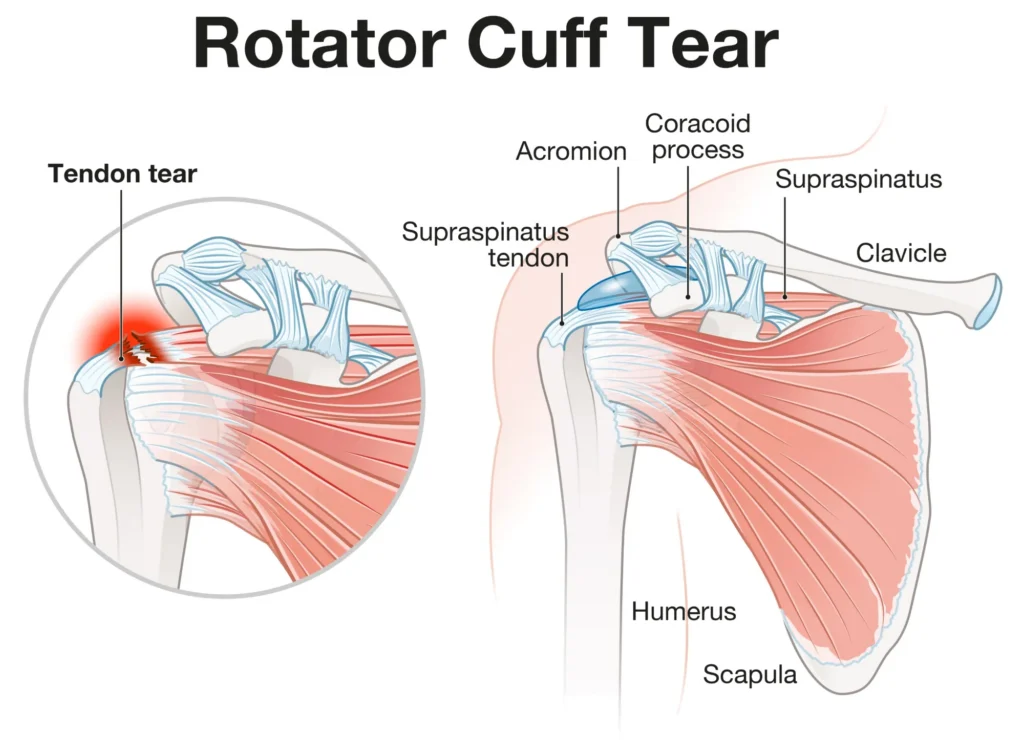
Not every rotator cuff tear needs surgery. Treatment depends on the size and pattern of the tear, whether it resulted from an acute injury, the amount of weakness, tendon and muscle quality, your overall health, and how much the symptoms interfere with the activities you want to do. Many degenerative tears improve with a focused exercise or physical therapy program, activity modification, and appropriate medications. A corticosteroid injection can sometimes provide short-term pain relief, but repeated injections are generally used cautiously, particularly when surgical repair may be considered.
For an active patient with a repairable tear, particularly one associated with significant weakness or an acute injury, arthroscopic rotator cuff repair may be appropriate. When a tear is massive and no longer repairable, treatment depends on pain, function, arthritis, and patient goals. In older adults with substantial weakness or loss of function—especially when rotator cuff tear arthropathy is present—a reverse shoulder replacement may be considered because it allows the deltoid muscle to power the shoulder even when the rotator cuff cannot function normally.
Glenohumeral Arthritis
Glenohumeral osteoarthritis develops when the smooth cartilage covering the ball and socket gradually wears away. As the joint space narrows, the shoulder can become painful and stiff, and bone spurs may form. Patients often notice progressive loss of motion, pain with daily activities, and sometimes grinding or catching. Reaching behind the back, getting dressed, sleeping, or performing overhead activities can become increasingly difficult.
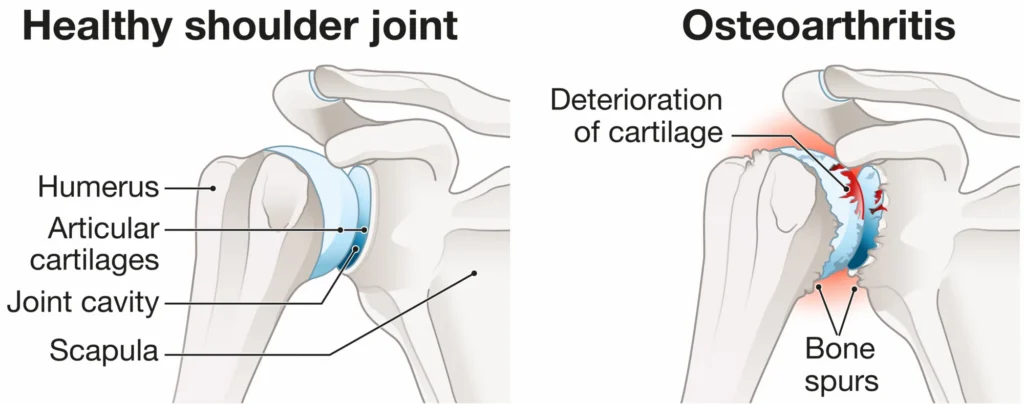
Early treatment is based on the severity of symptoms rather than the X-ray alone. Activity modification, range-of-motion work, strengthening, and anti-inflammatory medication when medically appropriate can help. A corticosteroid injection into the joint may provide temporary pain relief for some patients. When pain and stiffness begin to interfere substantially with quality of life despite nonsurgical treatment, shoulder replacement becomes a reasonable consideration.
For patients with an intact and functional rotator cuff, an anatomic total shoulder replacement can provide excellent pain relief and motion. A reverse shoulder replacement is often preferred when the rotator cuff is irreparable or when there is rotator cuff tear arthropathy, and it may also be selected in some older patients based on factors such as glenoid deformity, bone loss, rotator cuff quality, and overall anatomy. The best implant is individualized rather than determined by age alone.
Adhesive Capsulitis: The “Frozen” Shoulder
Frozen shoulder, also known as adhesive capsulitis, occurs when the shoulder capsule becomes inflamed, thickened, and contracted. It is most common between ages 40 and 60, but it can occur in older adults as well. The hallmark is progressive loss of both active and passive motion—meaning the shoulder is stiff whether you move it yourself or someone else tries to move it for you. Diabetes, thyroid disease, and a period of shoulder immobilization can increase the risk.
Treatment usually begins with maintaining motion through a home stretching program or physical therapy. A corticosteroid injection into the joint can be particularly helpful during the painful early phase. Most patients improve without surgery, although recovery can take many months. For persistent, severe stiffness that does not improve with appropriate nonsurgical care, manipulation under anesthesia or arthroscopic capsular release may be considered.
Proximal Humerus Fractures
Proximal humerus fractures involve the upper end of the arm bone near the shoulder. In older adults, they commonly occur after a ground-level fall, particularly when bone density is reduced. Typical symptoms include immediate pain, swelling, difficulty moving the arm, and bruising that may spread down toward the elbow over the next several days.
Most proximal humerus fractures can be treated without surgery when the bone remains in an acceptable position. Treatment commonly includes a sling for comfort followed by a gradual, guided return of shoulder motion. Surgery is reserved for selected fractures based on displacement, fracture pattern, bone quality, patient activity level, and the likelihood that the bone can be reconstructed reliably. Options may include plate-and-screw fixation or, for some complex fractures in older adults, reverse shoulder replacement.
Rotator Cuff Tendinopathy, Bursitis, and Calcific Tendinitis
Pain from the rotator cuff and the subacromial bursa is often grouped under terms such as rotator cuff tendinopathy, bursitis, or subacromial pain syndrome. Rather than simply being a tendon that is “pinched” by a bone spur, symptoms usually reflect a combination of tendon degeneration, inflammation, shoulder mechanics, and load. Pain is commonly felt along the outer shoulder and is often worse when lifting the arm or reaching overhead.
Patients may describe a painful arc as the arm is raised, discomfort when lying on the affected side, and pain with reaching or lifting. Weakness can also occur, but significant or progressive weakness raises more concern for a rotator cuff tear and deserves further evaluation.
Calcific tendinitis is a separate condition in which calcium deposits form within a rotator cuff tendon. It can produce anything from mild chronic discomfort to a sudden, severe flare of pain. The deposits are usually visible on a standard shoulder X-ray.
These conditions often improve with activity modification, a targeted exercise or physical therapy program, anti-inflammatory medication when appropriate, and selective injections. Calcific tendinitis that remains painful may also be treated with ultrasound-guided needling and lavage in selected cases. Arthroscopic surgery is generally reserved for persistent symptoms that have not improved with an adequate course of nonsurgical treatment; routine removal of a bone spur is not necessary for every patient with rotator cuff-related pain.
Signs It May Be Time to See an Orthopedic Specialist
Not every sore shoulder requires a specialist. A mild ache after an unfamiliar activity may settle with a short period of activity modification and simple measures. However, certain symptoms deserve evaluation, especially when they persist or interfere with sleep and daily function:
- Persistent shoulder pain that is not improving
- Pain that wakes you from sleep or makes it hard to find a comfortable position at night
- A noticeable decline in your ability to lift, reach, or rotate your arm
- Sudden onset of severe pain and inability to move the shoulder after a fall
- Grinding, catching, or popping that accompanies pain during movement
- Progressive weakness in the arm that is interfering with daily tasks
A shoulder evaluation starts with your history and a focused physical examination. For most older adults with persistent shoulder pain, standard X-rays are an important first imaging study because they can identify arthritis, fractures, bone loss, and other structural changes. Ultrasound or MRI may be recommended when the examination suggests a rotator cuff tear or another soft-tissue problem, but advanced imaging is not necessary for every painful shoulder.
Practical Steps for Protecting Your Shoulders
- Maintain shoulder and upper-back strength with regular, comfortable resistance exercise. The specific program should match your current strength, mobility, and medical conditions rather than pushing through significant pain.
- Keep moving. Regular shoulder motion and general physical activity help preserve strength and function, particularly after periods of illness or inactivity.
- Use good lifting mechanics. Keep heavier objects close to your body, use both hands when possible, and avoid suddenly lifting a heavy load far from your body or overhead.
- Reduce fall risk. Appropriate footwear, good lighting, balance and leg-strengthening exercises, and addressing vision or medication issues can help prevent the falls that commonly cause shoulder fractures in older adults.
- Pay attention to bone health. If you have osteoporosis or risk factors for low bone density, discuss screening and treatment with your primary care physician. Stronger bone can reduce the risk and severity of fractures after a fall.
Summary
Shoulder pain is common as we age, but it should not automatically be dismissed as “just getting older.” Rotator cuff disease, arthritis, fractures, and other shoulder conditions can often be treated effectively once the source of the problem is identified. The right treatment may be as simple as a focused exercise program or injection, while some patients benefit from rotator cuff repair or shoulder replacement. The key is matching the diagnosis and treatment plan to your symptoms, anatomy, health, and goals.
Frequently Asked Questions
What is the difference between a total shoulder replacement and a reverse shoulder replacement?
An anatomic total shoulder replacement recreates the shoulder’s normal ball-and-socket orientation and is commonly used when the rotator cuff is intact and functional. A reverse shoulder replacement changes the orientation of the joint so the deltoid can elevate the arm even when the rotator cuff is severely damaged. Reverse replacement is also used for many complex fractures and may be chosen for certain patterns of arthritis or bone loss. Your surgeon will recommend the option that best fits your anatomy, rotator cuff function, age, activity level, and goals.
How can I tell the difference between a rotator cuff problem and arthritis?
Rotator cuff problems and arthritis can overlap, and some patients have both. Rotator cuff disease more often causes pain or weakness with lifting and overhead activity, while arthritis commonly causes progressive stiffness, loss of motion, and pain throughout the range of motion. X-rays are particularly helpful for diagnosing arthritis; ultrasound or MRI may be used when more information about the rotator cuff is needed. A physical examination helps determine which imaging findings are actually responsible for your symptoms.
What should I expect during my first appointment with a shoulder specialist?
Your doctor will review how the problem started, what movements are difficult, whether pain affects sleep, and what treatments you have already tried. A focused examination evaluates motion, strength, and specific pain patterns. X-rays are commonly obtained at the first visit for persistent shoulder pain in older adults. An ultrasound, MRI, CT scan, or other study may be ordered if it would change the diagnosis or treatment plan. The visit should end with a clear explanation of the likely diagnosis and a treatment plan tailored to your goals.